



Sengong’s water-soluble PVA films have the lowest carbon footprint in the industry

Of all of the PVA films in the industry, we’ve got the lowest carbon footprint!
With climate change as a real threat, and the national Dual-Carbon initiative pressing on, many businesses are becoming more sensitive to carbon footprints and emissions. In support of low carbon goals, we’re pleased to announce an important milestone:

Sengong has achieved an industry-leading ultra-low carbon footprint for PVA film production!
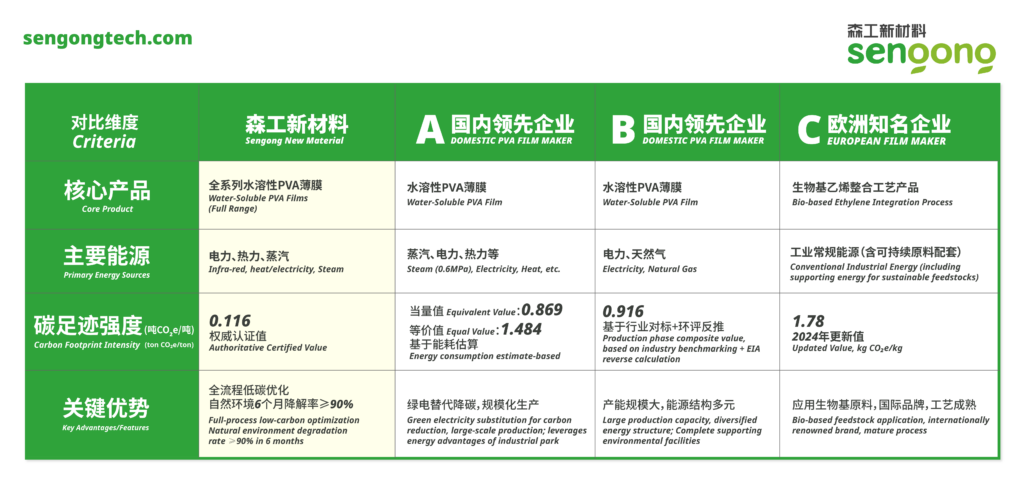
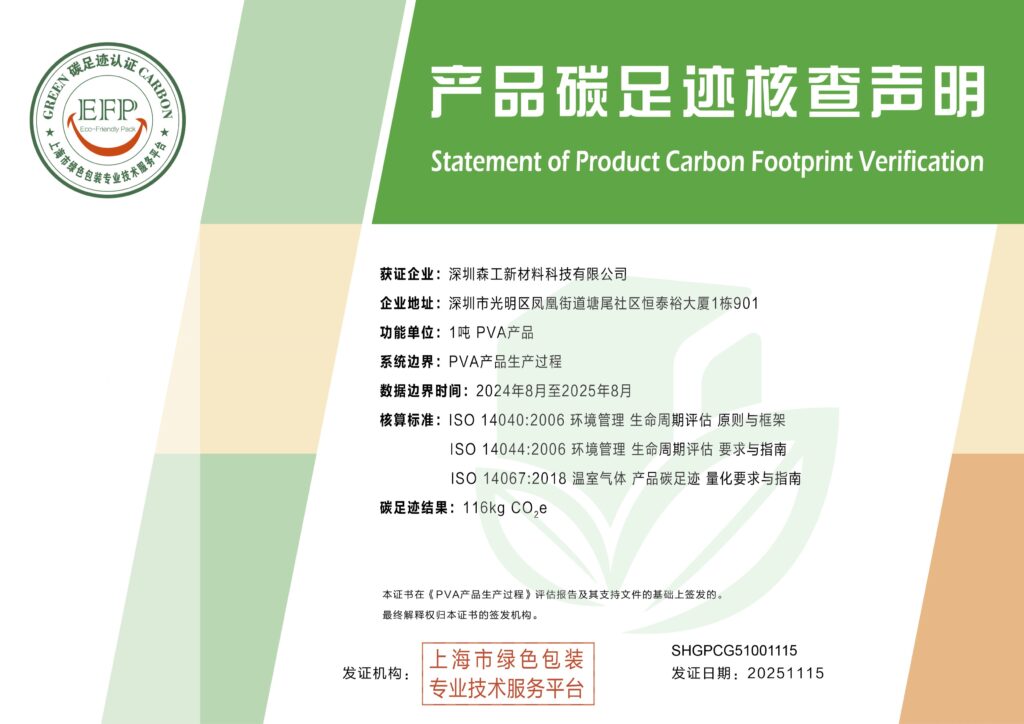
Having just completed a carbon emissions study of our PVA film manufacturing process by a 3rd-party professional team, our PVA film product’s official carbon footprint stands at just 0.116 tons CO₂e/ton (or 116 kg CO₂e/ton), about 86.7% lower than our nearest competitor.

How our carbon footprint was calculated
The carbon footprint measured is based on the total amount of emissions (direct & indirect) generated throughout a product’s entire lifecycle – from raw material acquisition, production, and processing to finished product delivery. It’s uniformly measured in CO₂e (carbon dioxide equivalent). The carbon footprint accounting was done according to global standards & procedures:

12-month period
The accounting covered our entire product production process, with a data collection period of 12 months from August 2024 – August 2025. This was to ensure the scientific rigor, accuracy, and traceability of the results.

Our carbon footprint compared with local & global PVA film makers
Our results are benchmarked against leading domestic and international PVA film producers. All carbon footprint data are sourced from publicly disclosed enterprise information, authoritative certification reports, environmental impact assessment approvals, and third-party accounting results. The accounting standard is based on “Cradle to Gate”, to ensure fairness & objectivity in the comparison.
 

Additional notes: (A)’s carbon footprint is calculated based on its publicly disclosed comprehensive energy consumption data (equivalent Value: 3985.26 tons standard coal/year; Equal Value: 6210.51 tons standard coal/year) using the local grid’s average carbon emission factor (0.7733 ton CO₂e/ton standard coal), aligning with the project’s actual energy structure. (B)’s EIA approval does not directly disclose comprehensive energy consumption, a dual-method calculation using “Industry Unit Energy Consumption Benchmarking (1.2-1.5 tons standard coal/ton product) + NOx Emission Reverse Calculation” was adopted, taking the median value to ensure rigor. (C)’s product carbon footprint accounting covers Scope 1, 2, and 3 (including raw material acquisition, transportation, production, etc.), consistent with Sengong’s “Cradle to Gate” philosophy, enabling direct comparison. Its data uses the IPCC AR6 GWP 100 methodology, a universally accepted accounting standard. All four standards focus on core PVA production and upstream related process emissions, excluding downstream use and end-of-life stages. The comparison dimensions are unified, and results serve as reference only.

We’ve just set a new industry benchmark for ultra-low-carbon footprint products

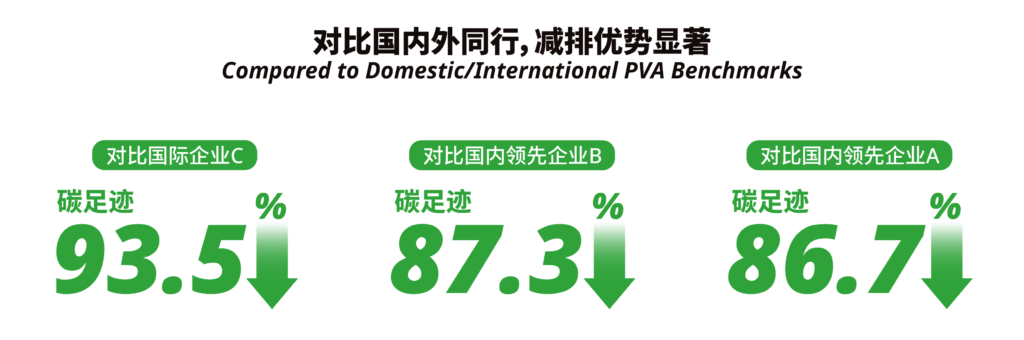
  • 93.5% reduction compared to (C), one of Europe’s biggest PVA film makers (1.78 ton CO₂e/ton). A ton of PVA product from Sengong has less carbon emissions (estimated at 1.664 tons CO₂e), equivalent to the annual carbon sequestration of 834 mature trees, exceeding the low-carbon standards of international, bio-based PVA manufacturing processes.
  • 87.3% reduction compared to (B) (0.916 ton CO₂e/ton), also a leading PVA film maker in China.
  • 86.7% reduction when compared to (A), a leading PVA film maker in China, (Equivalent Value: 0.869 ton CO₂e/ton)

This gives Sengong a leading position among domestic PVA film-makers, exceeding ALL standards in low-carbon technology by a local enterprise.
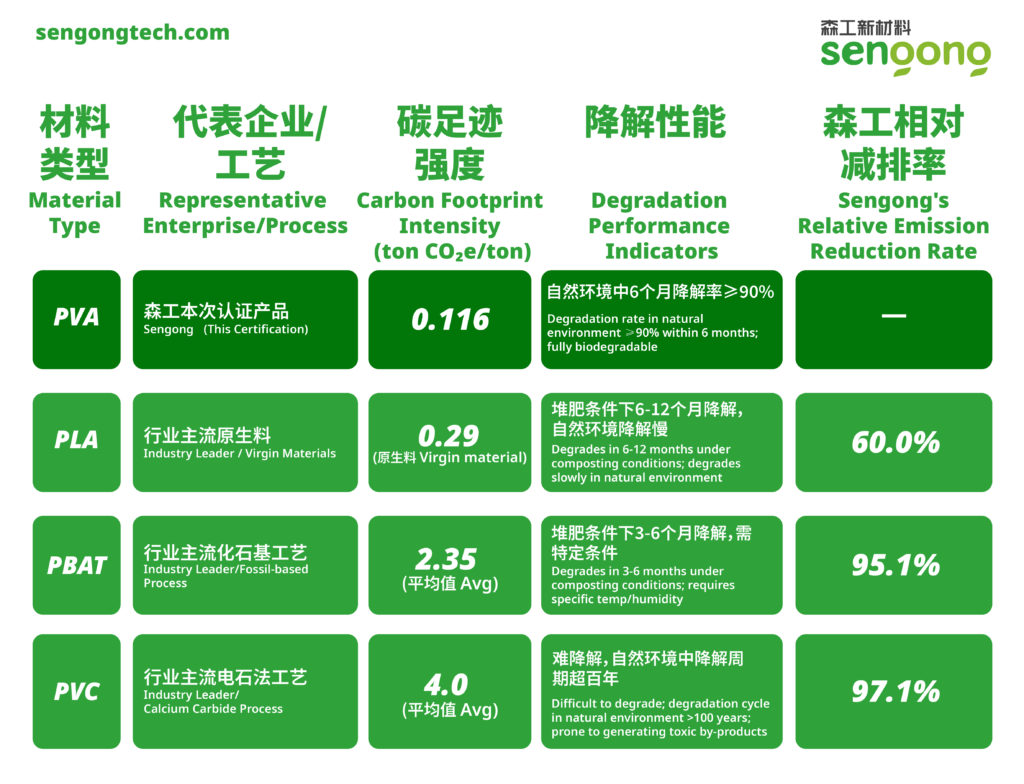
Cross-category comparison with mainstream biodegradable polymer materials
Our PVA material product features excellent biodegradability characteristics. This demonstrates superior synergy between carbon emissions and degradation performance, compared to materials like PLA, PBAT, and PVC:

While (C) has achieved low-carbon production through bio-based feedstock application, Sengong’s product carbon footprint is still 89.2% lower, reflecting superior efficiency levels in our production process and energy use. With international policies on carbon tariffs, such as the EU Carbon Border Adjustment Mechanism (CBAM), our ultra-low carbon footprint rating gives us significantly higher rankings over similar PVA film makers.
Who’s behind our new carbon footprint rating?
The carbon footprint verification for Sengong’s PVA products was supported by the Shanghai Green Packaging Professional Technical Service Platform. Established under the Shanghai Publishing and Printing College, this platform is a core component of Shanghai’s R&D Public Service Platform system, possessing authoritative low-carbon certification qualifications and extensive industry service experience.

Core team
The platform’s core services include carbon footprint accounting, Life Cycle Assessment (LCA), green packaging material testing, low-carbon technology consulting, etc. Its service scope supports multiple industries including packaging and chemicals in Shanghai and the Yangtze River Delta region. It has completed carbon footprint certifications for numerous biodegradable material enterprises, with results recognized by the industry, providing reliable technical support for corporate green transformation. The exercise was led by two senior experts from the platform, whose professional capabilities ensure the authority of the certification results:

  • Associate Professor Cui Qingbin: Associate Professor, National Technical Expert and Platform Core Specialist at Shanghai Publishing and Printing College. He specializes in green packaging technology and carbon reduction, edits textbooks, and promotes industry-university-research integration.
  • Associate Professor Shao Fenjuan:Associate Professor at Shanghai Publishing and Printing College, core technical expert of the platform. She has dedicated herself to biodegradable packaging and carbon accounting, and published academic works to support the low-carbon transformation of industries.

With the Shanghai Green Packaging Professional Technical Service Platform and professional expertise behind our new carbon footprint certification, our new carbon footprint’s result is  authenticity.

Conclusion
Our ultra-low carbon footprint certification for our PVA film products is a reflection of our green commitment to all of our products, our manufacturing processes, and our entire supply chain. It’s also a demonstration of our support for the national Dual-Carbon strategy.

By benchmarking against the standards long-held by domestic & international industry leaders, it also shows that fresh, new Chinese enterprises can achieve remarkable breakthroughs in low-carbon goals.

Also add this if smooth scroll is laggy