
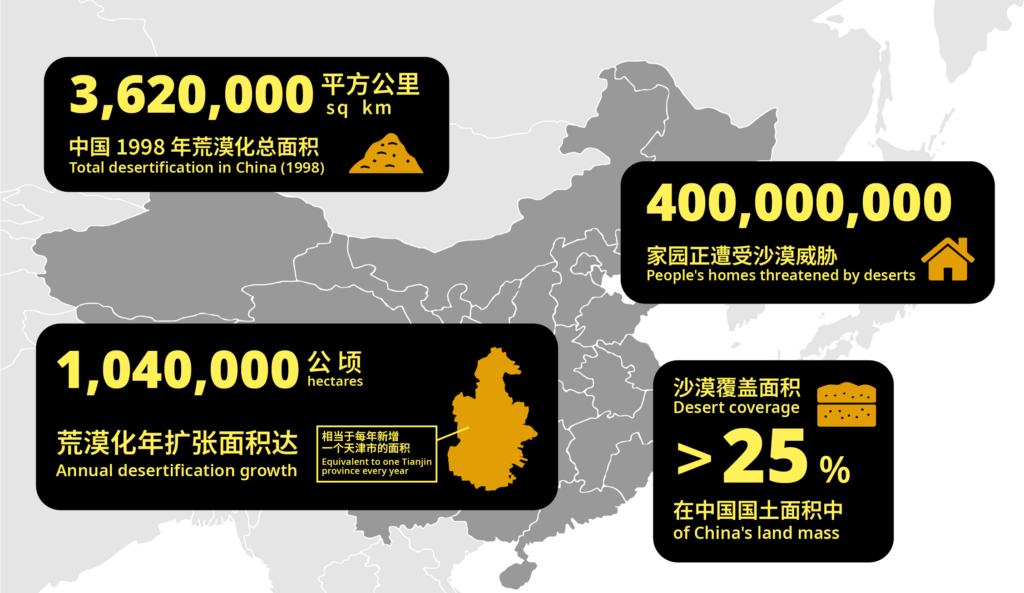
“In 1998, China’s desertification zone covered 3.62 million sq kms, which is over 1 quarter of China’s land mass. China’s forestry department has indicated that local desertification zones are increasing by 1.04 million hectares, on average, per year. To put this in context, China was losing an area roughly the size of Lebanon to the desert every single year. That threatens the homes of over 400 million people.”
Expanding, growing deserts is the direct cause of sandstorms & dust storms, frequent in China’s northern regions, including Beijing. On top of being physically destructive, it can cause health issues, as well as widespread economic damage.
Decades ago, the government started a program called the “Three-North Shelterbelt Program” to cut down desertification in the northern regions. And prevent the Gobi Desert from growing. Since then, it’s been expanded into an initiative known as the “Great Green Wall”: afforestation, reforestation & sand-control. It’s evolved and has expanded across 13 northern provinces. The target? Expand green coverage in the region, from the current 5%, to 15% by 2050.
The Taklamakan desert in the Xinjiang Uygur Autonomous Region is the second largest sand-shifting desert in the world covering 337,600 sq kms. Commonly known as the ‘Sea of Death’, it’s been reported that a green belt has fully encircled the desert.
Green vegetation is applied to stabilize the soil, to stop it from expanding. The current process is painstakingly complex, planting grids of straw to help stabilize the sands, and allow plantations to take root in the ground. Another more creative method is the placement of solar farms, where (1) solar panels can provide shade, and (2) the regular washing of the panels delivers moisture to the ground.
For reforestation to be effective, trees and vegetation need water to survive. Other factors matter as well, including vegetation that are drought- or pest-resistant. Shrubs and bushes, desert plants, are ideal for this purpose as they require less water to survive.
In the previous decades, traditional desertification control methods —such as straw checkerboards, sand barriers, and chemical consolidates — have achieved limited results. Typical methods come with drawbacks:
Our Eco-Earth Soil Enhancer, a PVA-based product, is a biodegradable liquid that loves water, helps to stabilize soil instantly & leaves no trace behind. It’s an environmentally friendly desertification control material that helps set sand/dust in place, help hold moisture, and biodegrades naturally upon use. Not only does it help reduce dusting, but it also encourages water retention, since PVA as a material is ‘water-loving’ – this is the same material that is applied in contact lens solutions.
After spraying, the solution penetrates between sand particles, and through the cross-linking of polymer chains, forms a flexible, breathable, and elastic three-dimensional network-structured film. This “artificial soil crust” delivers four key functions:

Locks moisture and nutrients in the sand layer, reducing evaporation by up to 70%. It creates a precious micro-moisture environment essential for seed germination and microbial survival.

After a period of use, the solution naturally decomposes and disappears. Under the action of soil microorganisms, it fully breaks down into harmless water and carbon dioxide, leaving no traces behind.

The consolidated layer can resist wind erosion, effectively fixing surface sand particles, suppressing dust, and preventing sand from being blown away (preventing desert expansion).

The product can be sprayed on a large scale mechanically using standard sprinkler trucks or professional irrigation equipment.
The core product is 100% biodegradable. Unlike plastic sand barriers, it does not cause secondary pollution; unlike some chemical stabilizers, it does not lead to soil toxicity. The essence of our material is to help restore the land’s vitality — not replace it.
Compared to traditional methods that rely heavily on manual labor, the wide area spraying of our Eco-Earth Soil Enhancer is far more efficient several times over. It is also suitable for urgent soil stabilization in large-scale projects to prevent landslides, as well as prevention of toxic dust spreads. The total lifecycle cost of our Eco-Earth Soil Enhancer is highly affordable, when all of these benefits are considered: labor savings, water conservation benefits, no post-use cleanup, and accelerated vegetation restoration.
Our Eco-Earth Soil Enhancer maintains its effectiveness until natural degradation, providing a critical window for vegetation recovery and ensuring the durability and stability of desertification control results.